文章ID:6158

一代女皇

8.86秒轻松超越博尔特!人形机器人百米竞速再次刷新纪录_我的网站

初代吸血鬼

一 |     8月26日消息,昨晚,第二届世界人形机器人运动会大型组100米复赛在北京国家速滑馆进行。

二 |     
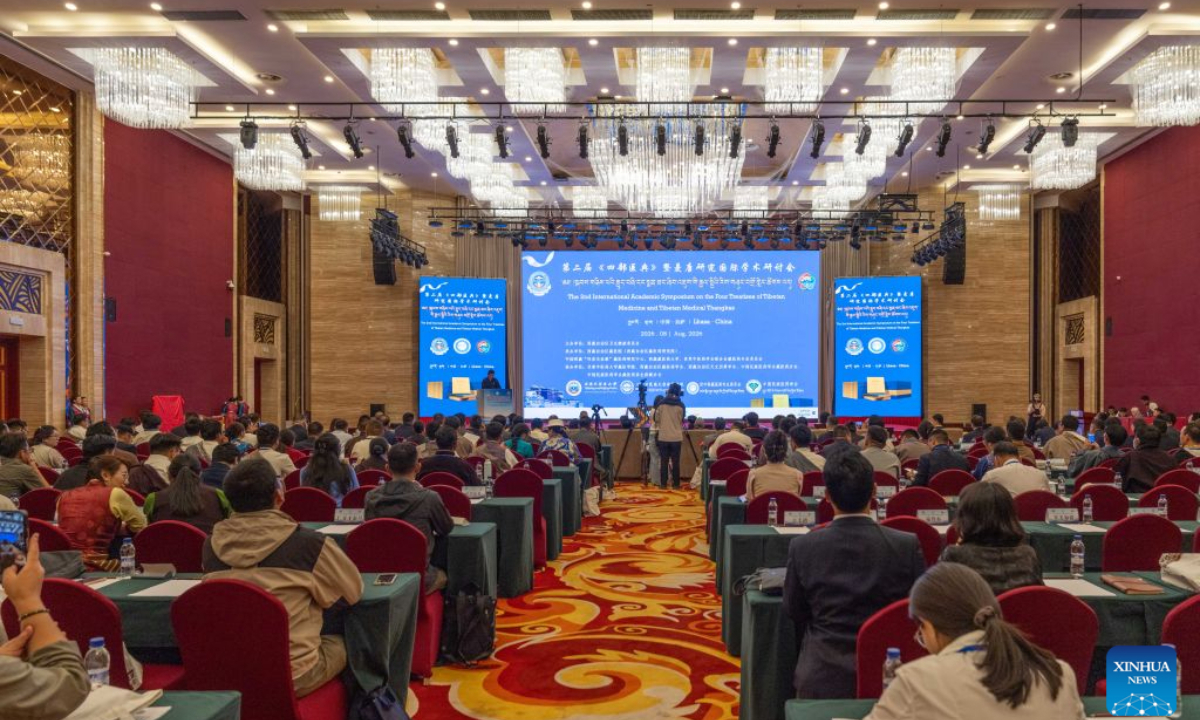
The second international academic symposium on The Four Treatises of Tibetan Medicine and Tibetan medical thangkas is held in Lhasa, southwest China's Xizang Autonomous Region, Aug. 20, 2026. An international symposium opened in southwest China's Xizang Autonomous Region on Thursday to shed light on the growing global interest in traditional Tibetan medicine and its visual illustrations drawn on thangkas. Held in the regional capital Lhasa, the second international academic symposium on The Four Treatises of Tibetan Medicine and Tibetan medical thangkas brought together more than 200 experts from China, Britain, Germany, Austria, Mongolia and Nepal. Discussions centered on the historical evolution of the classic treatises, the iconographic interpretation of Tibetan medical thangkas, and pathways for modern clinical application and international cooperation. Written between the 8th and 12th centuries, The Four Treatises of Tibetan Medicine is the most influential foundational work on traditional Tibetan medicine. It was inscribed on the UNESCO Memory of the World Register in 2023. Based on the work, the 80-scroll Tibetan medical thangkas serve as a visual teaching complement, covering diagnostics, pharmacology, preventive care and medical ethics. The medical thangkas were added to China's national documentary heritage list also in 2023. (Xinhua/Tenzing Nima Qadhup)
    The second international academic symposium on "The Four Treatises of Tibetan Medicine" and Tibetan medical thangkas is held in Lhasa, southwest China's Xizang Autonomous Region, Aug. 20, 2026. An international symposium opened in southwest China's Xizang Autonomous Region on Thursday to shed light on the growing global interest in traditional Tibetan medicine and its visual illustrations drawn on thangkas. Held in the regional capital Lhasa, the second international academic symposium on "The Four Treatises of Tibetan Medicine" and Tibetan medical thangkas brought together more than 200 experts from China, Britain, Germany, Austria, Mongolia and Nepal. Discussions centered on the historical evolution of the classic treatises, the iconographic interpretation of Tibetan medical thangkas, and pathways for modern clinical application and international cooperation. Written between the 8th and 12th centuries, "The Four Treatises of Tibetan Medicine" is the most influential foundational work on traditional Tibetan medicine. It was inscribed on the UNESCO Memory of the World Register in 2023. Based on the work, the 80-scroll Tibetan medical thangkas serve as a visual teaching complement, covering diagnostics, pharmacology, preventive care and medical ethics. The medical thangkas were added to China's national documentary heritage list also in 2023. (Xinhua/Tenzing Nima Qadhup)An international symposium opened in southwest China's Xizang Autonomous Region on Thursday to shed light on the growing global interest in traditional Tibetan medicine and its visual illustrations drawn on thangkas.
Held in the regional capital Lhasa, the second international academic symposium on "The Four Treatises of Tibetan Medicine" and Tibetan medical thangkas brought together more than 200 experts from China, Britain, Germany, Austria, Mongolia and Nepal.
Discussions centered on the historical evolution of the classic treatises, the iconographic interpretation of Tibetan medical thangkas, and pathways for modern clinical application and international cooperation.
At the symposium, a research center for Tibetan medical thangkas was inaugurated.
Written between the 8th and 12th centuries, "The Four Treatises of Tibetan Medicine" is the most influential foundational work on traditional Tibetan medicine. It was inscribed on the UNESCO Memory of the World Register in 2023.
Based on the work, the 80-scroll Tibetan medical thangkas serve as a visual teaching complement, covering diagnostics, pharmacology, preventive care and medical ethics. The medical thangkas were added to China's national documentary heritage list also in 2023.
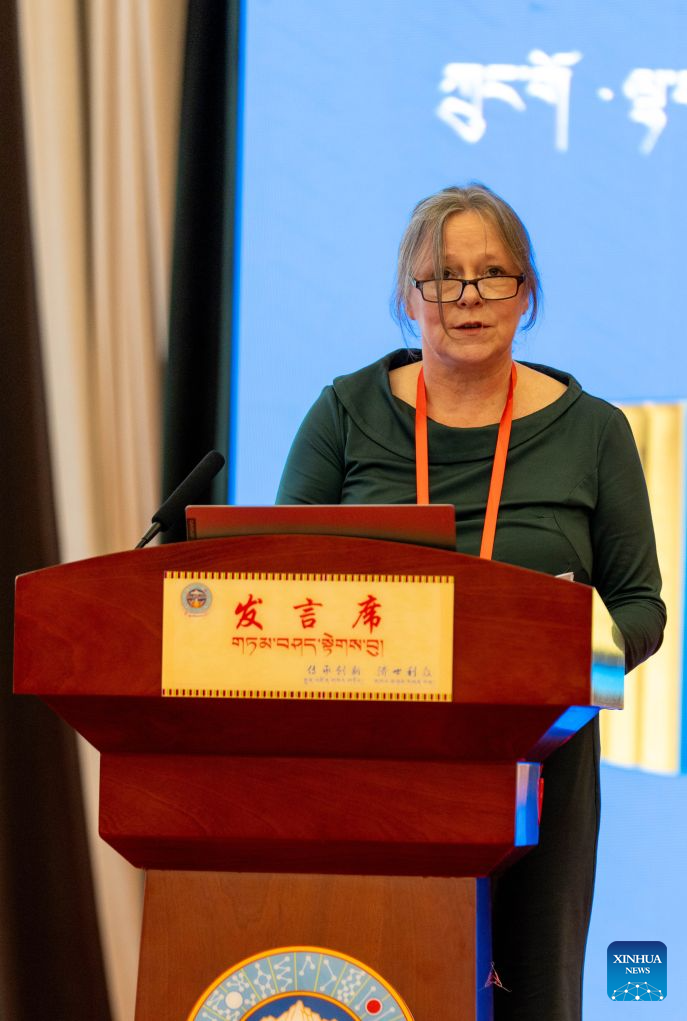
Among the participants was Katharina Anna Sabernig, a lecturer from the Medical University of Vienna, Austria, who first encountered Tibetan medical murals at Labrang Monastery in Gansu Province in 1994. She later returned and began delving deeper into the works.
"I saw these murals and I started to get deeper and deeper and to understand all this," Sabernig recalled.
Mary Caroline Wyatt, a scholar with dual British-Greek citizenship, began collaborating on an English translation of texts about Tibetan medical thangkas last September. She noted that complete English versions have long been scarce.
"Our translations target professional readers so that we preserve many specialized, traditional terms," said Wyatt.
The event was hosted by the regional health commission and co-organized by the regional Tibetan medicine hospital and Xizang University of Tibetan Medicine.
Xizang has formulated and implemented a series of policies on promoting Tibetan medicine and encouraging innovation. According to a government white paper released last year, the region has 51 public Tibetan medicine institutions, employing 5,287 professionals and operating 3,260 beds, up from 28 institutions, 2,232 professionals and 1,364 beds in 2012.
In April, China rolled out its first national recommended standard for ethnic-medicine disease classification and codes for Tibetan medicine.
Tsering, president of the regional Tibetan medicine hospital, said inscriptions on the UNESCO Memory of the World Register and China's national documentary heritage list have brought Tibetan medicine to a broader global audience.
"We will make the most of these opportunities to promote academic exchanges and clinical collaboration worldwide," Tsering said.
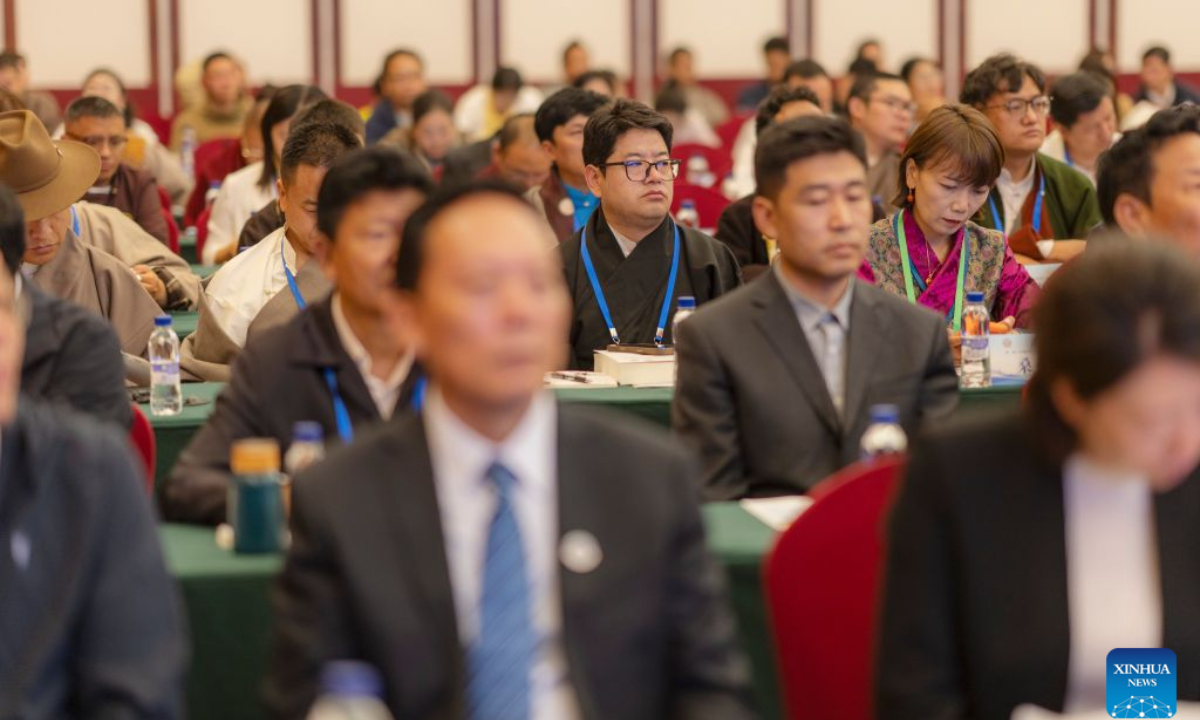
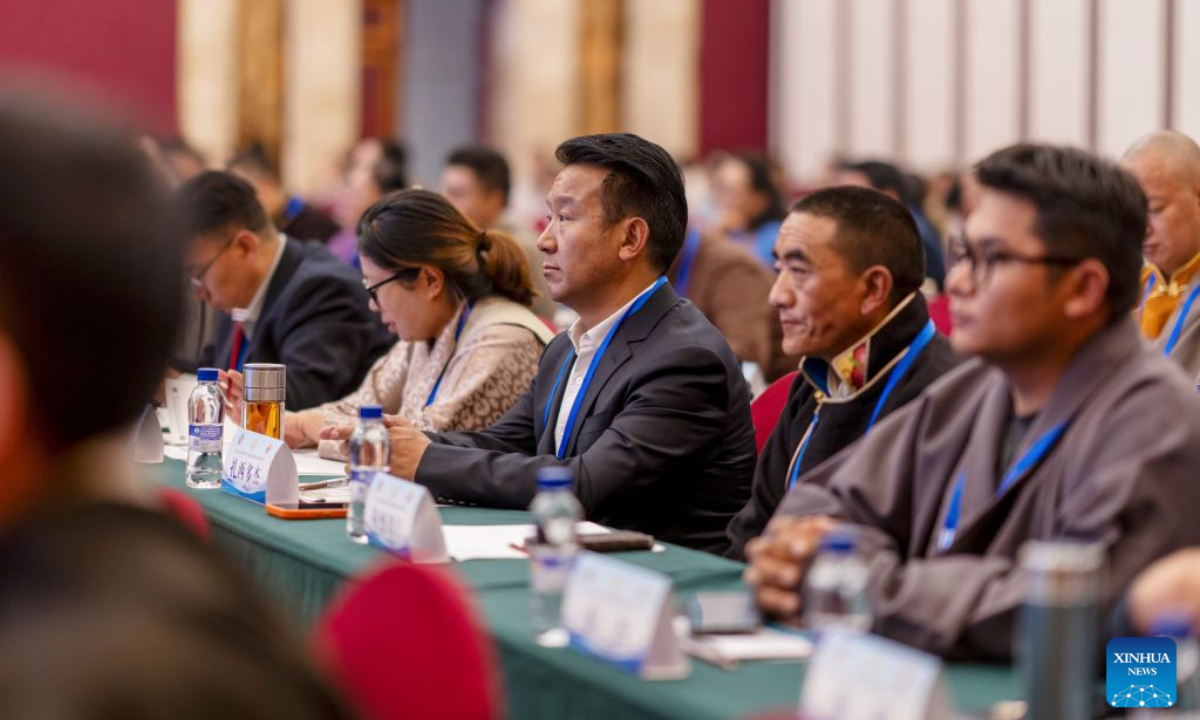
This photo taken on Aug. 20, 2026 shows a scene of the second international academic symposium on The Four Treatises of Tibetan Medicine and Tibetan medical thangkas in Lhasa, southwest China's Xizang Autonomous Region. (Xinhua/Liu Zhoupeng)
    This photo taken on Aug. 20, 2026 shows a scene of the second international academic symposium on "The Four Treatises of Tibetan Medicine" and Tibetan medical thangkas in Lhasa, southwest China's Xizang Autonomous Region. (Xinhua/Liu Zhoupeng)
This photo taken on Aug. 20, 2026 shows a scene of the second international academic symposium on The Four Treatises of Tibetan Medicine and Tibetan medical thangkas in Lhasa, southwest China's Xizang Autonomous Region. (Xinhua/Tenzing Nima Qadhup)
    This photo taken on Aug. 20, 2026 shows a scene of the second international academic symposium on "The Four Treatises of Tibetan Medicine" and Tibetan medical thangkas in Lhasa, southwest China's Xizang Autonomous Region. (Xinhua/Tenzing Nima Qadhup)
Katharina Anna Sabernig from the Medical University of Vienna, Austria, delivers a speech at the second international academic symposium on The Four Treatises of Tibetan Medicine and Tibetan medical thangkas in Lhasa, southwest China's Xizang Autonomous Region, Aug. 20, 2026. (Xinhua/Tenzing Nima Qadhup)
    Katharina Anna Sabernig from the Medical University of Vienna, Austria, delivers a speech at the second international academic symposium on "The Four Treatises of Tibetan Medicine" and Tibetan medical thangkas in Lhasa, southwest China's Xizang Autonomous Region, Aug. 20, 2026. (Xinhua/Tenzing Nima Qadhup)

三 |     本轮复赛竞争异常激烈,荣耀“闪电”机器人率先跑出8.94秒,刷新赛会百米竞速纪录;紧随其后的是来自北京人形机器人创新中心的天工Ultra,更是跑出8.86秒的成绩,再度刷新该赛事人形机器人百米竞速纪录。         在此前开幕式预赛中,这款机器人就已经跑出9.39秒,超越博尔特9.58秒的人类男子百米世界纪录;复赛阶段再度把成绩大幅压缩至8.86秒,较人类百米世界纪录快0.72秒。    百米冲刺非常考验人形机器人的综合能力,需要完成快速启动、极限加速,全程高速下维持躯体平衡,对电机响应速度、整机动力学算法、姿态控制都是极高考验。    资料显示,天工Ultra是北京人形机器人创新中心开发的全尺寸高性能人形机器人,属于天工系列的竞速耐力强化版本,是国内运动性能顶尖的双足人形机器人。    身高1.8米,体重55kg,体型接近成年男性,搭载大功率一体化伺服关节,配备六维力传感器、IMU惯性单元、3D视觉感知模块,具备力反馈与姿态感知能力。     同时还搭载“慧思开物”具身智能平台,依靠强化学习运动算法实现高速奔跑与抗干扰平衡,并支持电池快换,满足长距离连续运行需求。         值得一提的是,它还是全球首台完成半程马拉松的人形机器人:去年4月北京亦庄半马,用时2小时40分42秒跑完21.0975公里,全程自主运行,创造世界纪录

四 |     除了刷新人形机器人百米竞速最好成绩外,天工Ultra在本届赛事上还创下了另外两项世界纪录:     400米大型组决赛,跑出38.15秒夺得金牌,大幅领先超过人类(43.03秒);开幕式原地跳高展示,跳出2.8843米,高于人类原地跳高2.45米的最好成绩。    


     【本文结束】如需转载请务必注明出处:      责任编辑:落木     文章内容举报     

Current article:http://www.kelozhaichongbaoshuo.pics/nub8/u50.docx

Published on:01:15:50


用户评论
用户名:
E-mail:
评价等级:               
评价内容: