
康熙来了
中央控制屏幕太大了,好像在电影院里!从CES 2019看汽车的未来趋势_我的网站

一 |
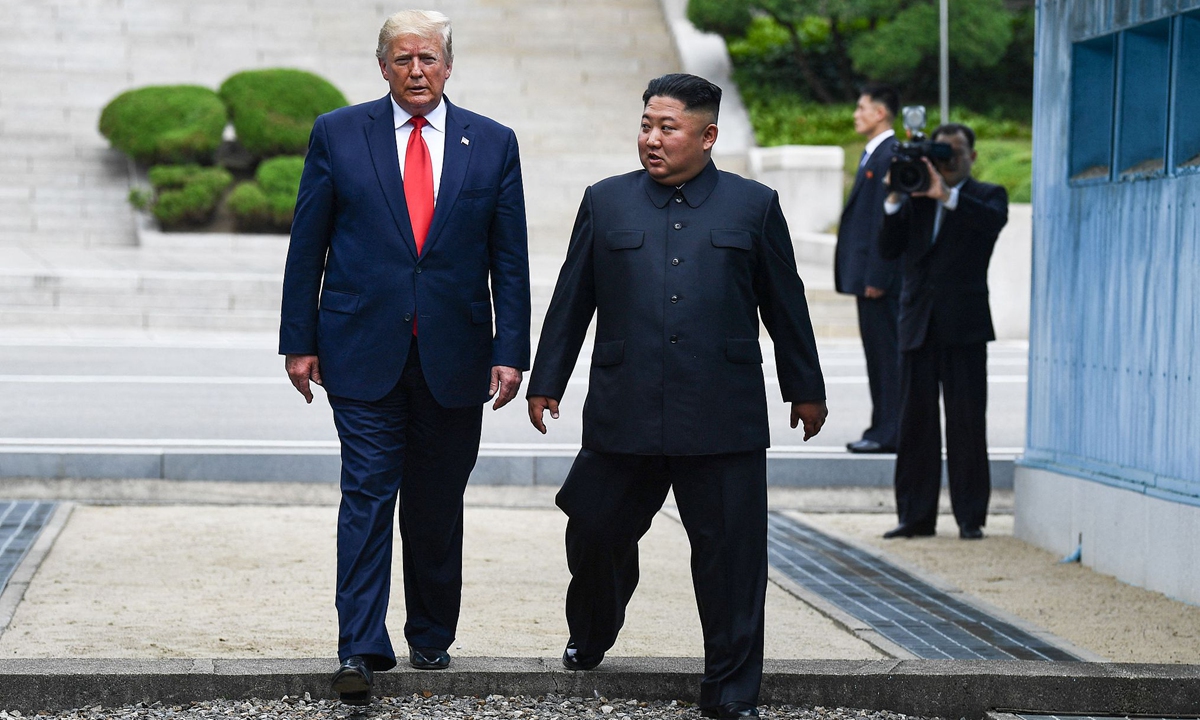
Just hours before a military exercise between the US and South Korea due to get underway on Monday, US President Donald Trump announced that Washington would reduce military exercises with key regional ally Seoul, citing his positive relationship with the North Korean leader and South Korea's lack of assistance with Iran, CNN reported.
Chinese experts see Trump's sudden decision to scale back military drills with South Korea as a signal of his intention to ease tensions on the Korean Peninsula and possibly return to direct diplomacy with Pyongyang. However, they warned that a carrot-and-stick approach may not work with Pyongyang, which has already seen Washington renege on its commitments. If Trump sincerely seeks peace on the peninsula, returning to the negotiating table with a genuine willingness to engage should be the first step.
Writing on Truth Social on Sunday, Trump said "based on my very good relationship with Kim Jong Un, of North Korea, I am not happy with the fact that the United States has, long ago, agreed to participate in Joint Military Exercises with South Korea."
"These exercises are not only costly, with much of these costs paid for by the United States of America (as usual!), but send a signal that is totally inappropriate and hostile, to a Country that, as long as Donald J. Trump has been President, has been unthreatening and respectful," wrote the US president, noting that since it was too late to cancel the exercises entirely, he had asked Defense Secretary Pete Hegseth to "substantially reduce" US participation.
The 11-day exercise, known as Ulchi Freedom Shield, was expected to involve about 18,000 South Korean troops. According to the US military, South Korean and US forces planned to conduct live-fire drills to test precision-strike and maneuver capabilities under complex operational scenarios, as well as river-crossing operations and the deployment of pre-positioned military supplies, South Korea's Chosun Ilbo reported.
Trump also reiterated his request for South Korea to help with the US war against Iran. "While somewhat unrelated, I recently asked the President of South Korea if they would like to join us in the Denuclearization of the Islamic Republic of Iran, and they said, 'No thanks!'" Trump wrote.
At a press conference of China's Foreign Ministry on Monday, a reporter also raised Trump's claim that he would scale back joint military exercises with South Korea, citing the high cost of the drills and his good relationship with North Korean leader, and asked how China would support the resumption of dialogue between the US and North Korea. Chinese Foreign Ministry spokesperson Lin Jian responded, "we have noted the relevant reports. Maintaining peace and stability on the Korean Peninsula and advancing the political settlement of the Korean Peninsula issue serve the common interests of all parties."
South Korean media Yonhap News Agency reported that Trump's instruction came as the situation on the Korean Peninsula remained tense again. The media noted that Trump's move can be seen as a conciliatory gesture toward the North Korea, after the White House repeatedly affirmed that Trump remains open to dialogue with Pyongyang "without any preconditions."
Trump has long sought to ease tensions on the Korean Peninsula, but his first-term diplomatic efforts produced few substantive results. The decision to scale back military exercises with South Korea may therefore signal an intention to send goodwill and return to direct diplomacy with North Korea, an unfinished piece of business from his first term, Song Zhongping, another Chinese military affairs expert, told the Global Times.
Long-standing tensions between the US and North Korea are a major source of instability on the Korean Peninsula, Lü Chao, an expert on East Asian studies at the Liaoning Academy of Social Sciences, told the Global Times, noting that the fundamental way to address these tensions is for the two sides to return to the negotiating table and resolve their differences through peaceful dialogue, rather than escalating tensions through displays of military force.
On August 13, a spokesperson for the Foreign Ministry of the Democratic People's Republic of Korea responded to the scheduled military drills between South Korea and the US. The spokesperson said that "it is our consistent principle of ensuring security to respond to a new level of a threat with a new level of a deterrent. DPRK remains steadfast in its will to frustrate outsiders' hostile acts with the most powerful and overwhelming force and absolutely defend the supreme interests of the state security," according to official Korean Central News Agency (KCNA).
On Saturday, Trump shared a photo of himself with Kim Jong Un, the top leader of the DPRK on Truth Social, and wrote that he and the North Korean leader "get along GREAT!"
During Trump's first presidential term, he and Kim first met in Singapore in June 2018, marking the first-ever US-DPRK summit. They met again in Hanoi, Vietnam in February 2019, and later that June in the inter-Korean border village of Panmunjom, according to Xinhua News Agency.
North Korea's past dealings with the US, particularly the breakdown of bilateral negotiations without substantial progress, have eroded Pyongyang's trust in Washington, Lü said.
Therefore, if Trump genuinely wants to leverage his relationship with the North Korean leader to address tensions on the Korean Peninsula, emphasizing their personal ties alone will not be enough. Washington will need to demonstrate genuine sincerity and back its words with concrete action, according to the expert.
。据路透社北京时间1月10日报道,今年许多汽车在CES上展出。

二 | 当你看到他们的中央控制显示屏时,你认为你已经进入电影院。

三 | ”这不是科幻小说!”电动汽车创业公司拜顿(Baiton)的董事长兼首席执行官卡斯滕•布莱特菲尔德(Carsten Breitfeld)在拉斯维加斯的CES展台上表示,他指的是该公司M字节内部令人惊叹的48英寸(1.22米)显示屏。巴顿的M-byte直到今年晚些时候才会批量生产,但其由中国面板制造商北京东方提供的超大显示屏证明,随着越来越多的网络化汽车的兴起,汽车行业有一个毋庸置疑的趋势。”屏幕是数字世界的窗口,”梅赛德斯-奔驰母公司戴姆勒(Daimler)首席设计师戈登瓦格纳(GordenWagener)表示。屏幕是新的马力。”2019年梅赛德斯eqc跨境汽车在同一个玻璃面板下有两个10.25英寸的显示屏,彼此独立。不仅未来的电动汽车和豪华汽车将增加中央控制屏幕的尺寸,而且克莱斯勒2019年的RAM1500卡车在仪表板上也有12英寸的垂直显示。除了中央控制台外,配有驾驶控制装置和后娱乐显示屏的仪表组的尺寸也在增加。奥迪等汽车制造商将中央控制台与仪表板结合在一起,这需要像拜仁这样的大屏幕和更大的计算能力。汽车制造商也在增加后视镜显示屏,以显示后视镜摄像头拍摄的照片。

四 | 同时,“平视显示器”(在挡风玻璃上投射图像以帮助驾驶员更好地了解路况)也显示出爆炸性增长。“我们生活在一个以展示为中心的世界里,”IHS Markit汽车研究主管BrianRhodes说。我认为这不是巧合。我们的车上有很多类似平板电脑的显示器。这显然是总体趋势。”根据IHS Markit,2018年全球汽车中央显示屏的平均尺寸为7.7英寸,预计到2024年将增至8.4英寸。罗德兹说,平视显示器是增长最快的部分。他说,目前全世界大约有630万辆汽车配备了这种显示器,但预计到2024年,这个数字将飙升至1410万辆。笨拙的用户体验?特斯拉是第一家用大屏幕竞争对手的公司。2012年,S型配备了17英寸液晶显示屏。苹果和谷歌随后推出了Carplay和Android Auto,允许驾驶员通过汽车的中央控制屏幕播放流媒体音乐、显示地图和其他应用程序。罗德兹说,这些公司的努力是汽车制造商采用更大屏幕的主要原因。

五 | 但苹果和谷歌在主要汽车显示屏上的出现也引起了汽车制造商的反思,他们不愿意为技术竞争对手提供如此有价值的平台,但渴望为消费者带来iPhone所需的体验。Gartner汽车研究主管MikeRamsey表示,目前的紧张局势依然存在。一些汽车制造商一直被动地整合苹果或谷歌的技术,往往导致糟糕的用户体验。

六 | 拉姆齐说,在某些情况下,他们增加了屏幕,对用户没有任何真正的好处。

七 | 10月,美国权威杂志《消费者报告》取消了对菲亚特-克莱斯勒、福特和本田车型的推荐,原因是消费者在死屏幕或空白屏幕上的反馈。尽管这些问题源于驱动内容的后端技术,而不是屏幕本身,但罗德说,“这对消费者来说是一样的。”清晰是汽车制造商说,如果处理得当,大型显示器可以通过提供更多信息来提高汽车安全性的关键,例如信号灯即将变红。他们说,随着屏幕越来越大,驾驶员的注意力将减少,而不是增加,因为驾驶员将不再需要在小屏幕上与大量选项作斗争。

八 | ”“你需要一个地方,以一种有效且不分散注意力的方式直观地向司机显示信息,”拜顿数字技术副总裁陈泰宇说。

九 | 福特用户体验部负责人鲁思·范恩(Ruth Vann)本月表示,为2020年福特探索者(Ford Explorer)设计的可选10英寸和标准8英寸显示器旨在防止驾驶员因信息重叠而沉浸在过多的数据中。”我们在驾驶时锁定某些功能,并鼓励驾驶员使用语音命令,”她说。

十 |
Current article:http://www.kelozhaichongbaoshuo.pics/x6q/20260826/224.doc
Published on:00:09:45


