
金婚Exclusive: 'Super map’ rewrites moon’s geo-clock, ‘an important foundation for humanity to explore deep space,’ project scientists tell GT_我的网站
一 | 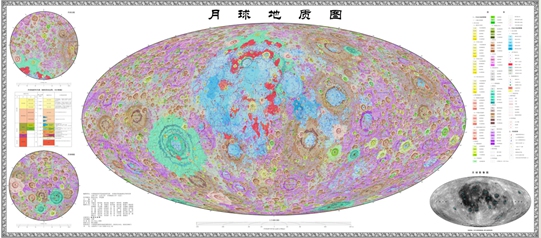 A massive new geological map of the moon, measuring about 2.8 meters long and 1.2 meters high, has recently made its debut in China, offering one of the most comprehensive portraits yet of the lunar surface and its billions of years of geological evolution. Compiled by the Institute of Geology under the Chinese Academy of Geological Sciences (CAGS), together with the Institute of Geochemistry under the Chinese Academy of Sciences, Jilin University, Shandong University and China University of Geosciences (Beijing), the 1:5,000,000-scale Geological Map of the moon marks 13,519 impact craters, 81 impact basins, 14 types of geological structures and 17 rock types, and includes detailed inset maps of the lunar north and south poles. More than simply a new rendering of the lunar surface, the map incorporates the latest findings from China's Chang'e lunar exploration program. Scientists involved in the project told the Global Times in exclusive interviews that the new map recalibrates key boundaries in the moon's geological chronology, updates the distribution of important lunar rock types and establishes a more systematic framework for interpreting the moon's evolution. "The Chang'e-5 and Chang'e-6 missions have successively returned samples from the moon's near and far side, producing findings that have significantly changed our understanding of lunar evolution," Ding Xiaozhong, a researcher at the Institute of Geology under CAGS and a core member of the mapping team, told the Global Times. Samples showed that volcanic activity on the moon continued until about 2 billion years ago - roughly one billion years later than previously thought under the conventional framework. Meanwhile, observations and samples from the lunar far side have provided new information about the composition and magmatic history of the moon's deep interior, Ding said. "These new discoveries created an urgent need for a new and systematic geological map that could integrate the latest data and research results and establish an updated framework for understanding lunar geology," he noted. The 1:5,000,000 scale was chosen with practical applications in mind. Compared with China's more detailed 1:2,500,000 lunar geological atlas released in 2024, the new map provides a more condensed, global view of the Moon, enabling researchers to quickly identify major geological relationships while also making it suitable for education, popular science and the early-stage planning of exploration missions. Jin Ming, an associate researcher at the Institute of Geology under CAGS, told the Global Times that the project also represents an important step toward establishing a mature Chinese standard for planetary geological mapping. Its newly designed symbols, legends and color system have been certified as a group standard by the Geological Society of China, filling a gap in China's standardized rules for planetary geological mapping. Although the latest project formally began in 2022 and took about four years to complete, Ding and Jin said its scientific foundations stretch back decades. Data accumulation and methodology development began with China's early lunar exploration missions, particularly after Chang'e-1 started returning scientific data. Several generations of Chinese planetary geologists have since developed a comprehensive system for lunar geological interpretation, remote-sensing data processing and map compilation. One of the toughest challenges was bringing together enormous quantities of remote-sensing data obtained by different instruments, Jin said. Different payloads aboard the Chang'e probes produced data with varying resolutions and spectral characteristics, requiring specially developed algorithms as well as extensive manual verification to place them under a unified mapping standard. "We had to make the different datasets compatible under the same system while striking a balance between scientific completeness and visual clarity - avoiding information overload without losing critical geological clues," Jin said. China previously released the world's first 1:2,500,000-scale high-precision lunar geological atlas in 2024. The newly completed 1:5,000,000 map is therefore not simply a reduced-scale copy, the scientists stressed, but a scientific update incorporating newly available data and revised interpretations of lunar chronology, lithology and geological evolution. China's new lunar geological map has achieved an all-round improvement over previous versions and is now at the international forefront, Ding said. We are the only country to have exclusive access to directly measured sampling data from the Chang'e-5 and Chang'e-6 missions. By using age anchors from lunar samples independently obtained by China to calibrate the geological chronology, this new data source and calibration system represents a core advantage of China." Like Earth, which is divided into geological periods such as the Cambrian and Jurassic, the Moon also has a geological timescale. One of the most significant tasks behind the new map was to recalibrate that "lunar clock." According to Jin, the recalibration draws on two major sources - the latest international isotopic dating results, including updated measurements of Apollo samples and lunar meteorites, and the precise age obtained from Chang'e-5 samples. The latter provided an especially important chronological anchor. Radiometric dating of Chang'e-5 basalt has placed its age at roughly 2 billion years, demonstrating that lunar volcanism persisted far later than had once been assumed and substantially changing scientists' picture of the moon's late-stage thermal evolution. Based on the updated evidence, the team refined the starting ages of several ancient lunar periods, including the Aitkenian, Nectarian and Imbrian periods, to approximately 4.33 billion, 4.17 billion and 3.92 billion years ago, respectively. More significantly, the researchers used the 2-billion-year age boundary to divide the Eratosthenian into an early and a late epoch. The team said this marks the first time an age boundary derived from samples independently collected by China has been incorporated into such a detailed Chinese lunar geological chronology. "The moon's story itself has not changed, but its timeline has," Jin said. "We once thought that major lunar volcanism had essentially cooled down about 3 billion years ago. Now we know that the Moon remained volcanically active until at least about 2 billion years ago. That means the thermal evolution of the lunar interior and many of the causal relationships in its later history need to be re-examined." Ding highlighted a newly mapped rock type in the South Pole-Aitken Basin - gabbronorite - identified with the help of the latest Chang'e-4 and Chang'e-6 exploration results. The vast basin on the lunar far side is one of the moon's largest and oldest impact crater. "This is like being able to directly see material from deeper inside the moon," Ding said. "Previously, much of this could only be inferred from remote-sensing observations. With Chang'e-4 in-situ exploration and Chang'e-6's returned samples, we now have much stronger evidence for identifying its existence and distribution." Another important revision concerns KREEP, a lunar geochemical component enriched in potassium, rare-earth elements and phosphorus and commonly associated with elevated concentrations of radioactive heat-producing elements such as thorium and uranium. According to Ding, earlier models suggested that KREEP-rich material was concentrated in a relatively limited area. Higher-resolution data used in the new mapping project indicate a broader and more continuous distribution than previously thought, suggesting that its abundance may have been underestimated. Ding said the finding is scientifically important not only for assessing potentially resource-rich lunar materials, but also because the distribution of KREEP provides clues to the crystallization of the early lunar magma ocean, the thickness of the lunar crust and the moon's internal thermal evolution. The map's colors also carry geological meaning. The team follows a principle of "lighter for younger, darker for older": relatively young Copernican impact materials are depicted in bright pale yellow, ancient Aitkenian impact materials in deep purplish red, while mare basalts are represented in varying shades of blue. "The color system combines the logic of geological evolution with elements of traditional Chinese color aesthetics, giving China's lunar geological maps a distinctive scientific and visual identity," Ding said. Beyond basic science, the researchers said the new geological map can serve as a strategic base map for China's future lunar exploration, including subsequent Chang'e missions and planning related to the International Lunar Research Station (ILRS). A refined geological chronology can help scientists understand the age and modification history of candidate regions; updated rock mapping can identify areas of particular scientific or resource interest; and the global-scale representation allows mission planners to compare broad regions before moving to higher-resolution site studies. Asked whether the map could directly support the Chang'e-7 and Chang'e-8 missions, Jin stressed that its role is primarily strategic rather than tactical. "The 1:5,000,000 geological map is a global-scale foundational map. It can be used for broad comparisons of potential landing regions and for evaluating their overall geological context," Jin said. "Precise landing-site selection and detailed rover-route planning, however, require higher-resolution regional geological maps. The two work together, moving progressively from the global scale to finer regional scales." The scientists also stressed that the map is intended to be shared with the international scientific community. Digital versions are expected to be released through professional publications and public scientific databases, while the standardized symbols and mapping rules could facilitate exchanges with other planetary geological mapping systems. Ding said significant room remains for international cooperation, from comparing and translating different geological mapping standards to joint studies of the evolution of the lunar far side and the origin of the ancient South Pole-Aitken Basin. "China possesses unique exploration data and returned lunar samples, which provide a strong foundation for cooperation," Ding said, adding that planetary science, scientific training and deep-space exploration technologies all offer potential areas for expanded exchanges. "A precise geological map of the moon is an important foundation for humanity to explore deep space and understand the universe," Jin said. The latest map, he noted, is not an endpoint. As China proceeds with subsequent lunar exploration missions and acquires new observations and samples, the geological picture of the Moon will continue to be refined. "Future exploration will allow us to keep updating our understanding of lunar geology," Jin said. "At the same time, we hope these results can contribute to broader international scientific cooperation and to humanity's exploration of the moon." 。
二 | "다음 총선 과반 승리·정권 탈환해야"당원직선제 포함 '4대 혁신 프로젝트' 발표시기·속도는 의견 수렴…보수 정체성 강화도 장동혁 국민의힘 대표가 26일 취임 1주년을 맞아 "당원주권 2.0 시대를 열겠다"며 시·도당위원장과 당협위원장 선출에 당원이 직접 참여하는 내용 등을 담은 쇄신안을 발표했다./남용희 기자[더팩트ㅣ여의도=김시형 기자] 장동혁 국민의힘 대표가 26일 취임 1주년을 맞아 "당원주권 2.0 시대를 열겠다"며 시·도당위원장과 당협위원장 선출에 당원이 직접 참여하는 내용 등을 담은 쇄신안을 발표했다. 특히 의원총회에서 제동이 걸린 당협위원장 '당원 직선제'에 대해 재추진 의지를 거듭 밝히며 "방향성과 확고한 신념에는 변함이 없다"고 강조했다.장 대표는 이날 오전 서울 여의도 중앙당사에서 취임 1주년 기자회견을 열고 '당원주권 2.0'을 비롯한 4대 혁신 프로젝트를 추진하겠다고 밝혔다.장 대표는 "시·도당위원장, 당협위원장 선출 등에 당원이 직접 참여하도록 해 당원 주권을 확대해 나가겠다"며 "모바일 당원증, 당원 제도 세분화 등 당원의 주인의식을 높일 방안도 추진하겠다"고 말했다.당 조직관리 시스템도 손질한다. 장 대표는 "당무감사 평가지표 개선, 당원 교육 체계화 등을 업그레이드하고 당무 혁신을 위한 당헌당규 개정도 추진할 계획"이라며 "당원주권 2.0 위원회를 조속히 출범시킬 것"이라고 했다.선출직 평가제도도 개편하기로 했다. 장 대표는 "국회의원, 광역단체장, 기초단체장, 지방의회 의원들을 대상으로 새로운 평가제도를 구축하겠다"며 "지방선거 공천 때 선보였던 청년 오디션 등 청년과 여성이 마음껏 도전할 수 있는 평가 시스템을 도입할 것"이라고 밝혔다. 장 대표는 의원총회에서 제동이 걸린 당협위원장 '당원 직선제'에 대해 재추진 의지를 거듭 밝히며 "방향성과 확고한 신념에는 변함이 없다"고 강조했다./남용희 기자청년 정당을 위한 TF 신설 계획도 밝혔다. 장 대표는 "부동산 정책 정상화 특위 내에 '청년주거 TF'를 구성해 청년 맞춤형 주거 대책을 세우고 올해 신설된 노동국을 중심으로 '일자리 TF'를 만들어 AI 시대에 맞는 노동개혁 방안을 찾겠다"고 했다.민생 정당을 위한 당대표 직속 '민생활력 PLA 위원회'도 설치한다. 장 대표는 "경제, 외교, 안보, 청년, 미래 등 각 분야의 이슈를 주도할 수 있도록 현장점검, 입법, 사후관리에 이르는 체계적인 민생정책 관리 시스템을 구축할 것"이라고 했다.소통 정당을 위한 확대 당직자 회의 정례화도 약속했다. 장 대표는 "현장 중심 상설위원회도 운영하고 우리 사회 각 직능단체와의 MOU도 적극 확대할 것"이라며 "세대별, 계층별, 지역별로 프로그램을 다양화해 국민과의 직접 소통 기회를 늘리겠다"고 했다.보수 가치 재정립을 위한 기록관 설립도 추진한다. 장 대표는 "국민의힘은 대한민국의 정통 보수정당"이라며 "보수의 DNA와 역사를 체계적으로 재조명할 수 있도록 온라인, 오프라인 기록관을 설립하고 당의 강령과 기본정책도 새롭게 개편할 것"이라고 했다. 이를 위해 '보수정체성확립위원회'도 설립하기로 했다. 장 대표는 26일 오전 서울 여의도 중앙당사에서 취임 1주년 기자회견을 열고 '당원주권 2.0'을 비롯한 4대 혁신 프로젝트를 추진하겠다고 밝혔다.배정한 기자장 대표는 "지난 1년이 무너진 당을 일으키고 흩어진 보수를 결집하는 시간이었다면, 지금부터는 본격적으로 승리의 교두보를 쌓는 시간"이라며 "안으로부터 개혁해 완전한 변화를 이끌겠다"고 강조했다.그러면서 "이재명 정권이 대한민국을 무너뜨리도록 그냥 놓아두어서는 안 된다"며 "다음 총선에서 과반 승리를 거두고 반드시 정권을 탈환해야 하는 치열한 여정의 출발선에서 결집된 당심을 토대로 민심의 바다로 나아가겠다"고 덧붙였다.장 대표는 의총에서 반대 의견이 모인 당협위원장 당원 직선제를 어떻게 관철할 것이냐는 취재진 질문에 "당심을 얻어 총선에 출마하고 총선에서 민심을 얻어 승리하는 게 당협위원장들의 최종 목표"라며 "당헌당규에 따라 당심을 얻은 당협위원장들이 위원장직을 이어가는 게 지극히 당연한 것"이라고 답했다.이어 "방향성과 확고한 신념엔 변함이 없다"며 "시기와 속도에 대해 여러 우려가 있는 만큼 많은 분들의 의견을 참고해 합리적인 기준을 찾아나갈 것"이라고 덧붙였다.발로 뛰는 더팩트는 24시간 여러분의 제보를 기다립니다.▶카카오톡: '더팩트제보' 검색▶이메일: [email protected]▶뉴스 홈페이지: http://talk.tf.co.kr/bbs/report/write。 Current article:http://www.kelozhaichongbaoshuo.pics/o3et/sug.html Published on:03:50:33 |

