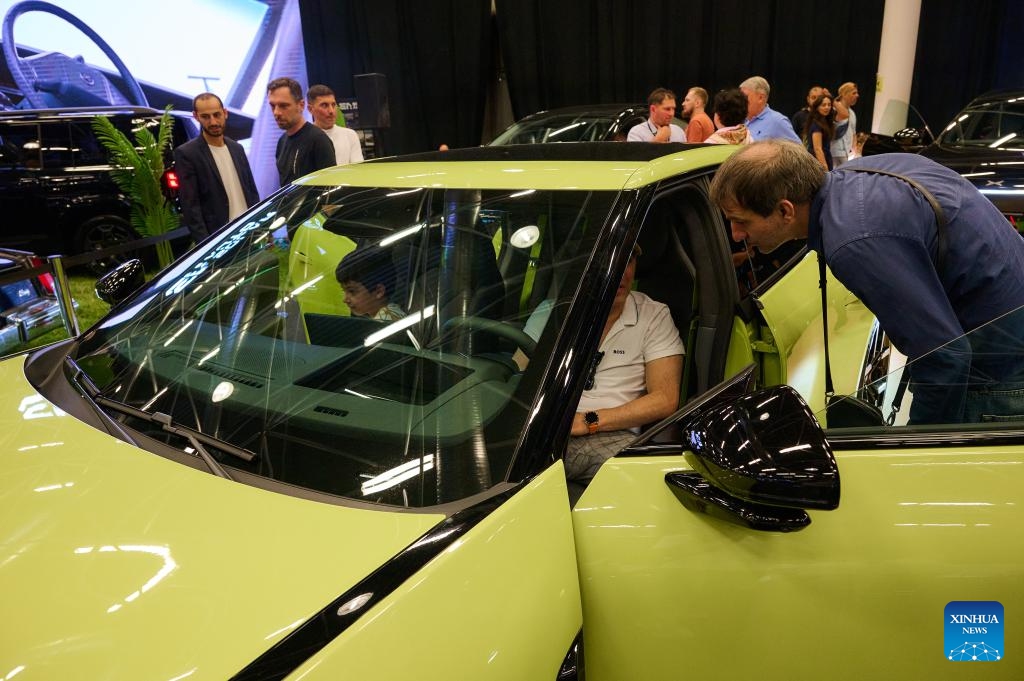
Visitors view an Xpeng electric vehicle at Expo Georgia in Tbilisi, Georgia, June 13, 2026. This year's expo was held here from Saturday to Sunday. Chinese automakers including BYD, XPeng, AVATR and JAC Motors have made appearances with their products at the expo. (Photo: Xinhua) China-made electric vehicles (EVs) accounted for 14.2 percent of European market sales in the first five months of 2026 despite the EU's steep tariffs. The growth showed that trade‑protectionist barriers can only serve as short‑lived obstacles, as consumers' purchasing choice ultimately hinges on product competitiveness and China's EV strengths will support the automakers' long‑term growth, Chinese experts said. The market share of electric cars sold by Chinese companies rose to 14.2 percent in European market in the first five months of this year, according to Schmidt Automotive Research. The 171,800 EVs sold there represented an increase in market share of five percentage points from one year earlier, the Guardian reported on Sunday. The increase in European sales comes despite EU tariffs of up to 35.3 percent for EVs made by some Chinese manufacturers, on top of the standard 10-percent import duty. The UK is the largest European market for Chinese cars because London has declined to follow the EU's lead in imposing more levies. The UK accounted for a quarter of Chinese EV sales in Europe, according to the report. Cui Dongshu, secretary-general of the China Passenger Car Association, told the Global Times on Monday that the surge showed trade protectionist policies have failed to contain Chinese automakers' overseas expansion. Chinese EVs enjoy "a generational edge" over Europe's legacy carmakers. Their overall product strength remains the primary reason behind their popularity among European buyers, Cui said. Meanwhile, fluctuating global oil prices have pushed up driving costs throughout Europe, fueling demand for affordable electric vehicles, a need well‑met by the affordable Chinese‑made models. Meanwhile, the gradual return of European electric‑vehicle purchase subsidies has lowered purchase barriers and lifted total EV sales, which has in turn worked to the advantage of Chinese exporters, Cui Dongshu said. Chinese brands expanded their market share in Europe in the first half of 2026 driven by local subsidies and higher oil prices, Fitch Ratings said in a report sent to the Global Times. The combined market share of leading Chinese brands in the EU, European Free Trade Association and UK rose to 11 percent in the first half of this year, up from 7 percent in the first half of 2025. The largest Chinese players, Geely Group (including Volvo Car) and SAIC Motor, expanded steadily despite the tariffs. The main drivers of market share gains were BYD, Chery and Leap Motor, according to Fitch Ratings. Cui Dongshu noted that China's EV edge comes from its full‑fledged industrial ecosystem. Officials from China's Ministry of Commerce told a press conference on July 28 that China boasts a complete, high‑efficiency EV industrial chain covering raw materials, auto parts, finished cars and production equipment, with industry clusters enabling rapid component supplies. China's huge market, the world's largest, has fueled 11 consecutive years of EV sales. "Protectionism can only put up short‑term entry barriers. It cannot erase the solid strengths of Chinese EVs or stop Chinese brands from establishing a lasting foothold in Europe," Cui Dongshu said. Yet, geopolitical risks remain as the EU reportedly considers expanding tariffs to restrict Chinese plug-in hybrid EVs. German media Handelsblatt reported on June 19 that the EU is drawing up new measures to shield its single market more tightly against Chinese imports in the near future, citing senior EU officials and industry insiders. Specifically, the plan could contain countervailing duties to be levied on Chinese‑made plug‑in hybrids. The rising market share of Chinese‑brand EVs amid EU tariffs has demonstrated that trade barriers cannot distort market choices. If the EU carries out its planned countervailing duties on Chinese plug‑in hybrids, the measure will yield only limited results, Cui Hongjian, a professor at the Academy of Regional and Global Governance at Beijing Foreign Studies University, told the Global Times on Monday. Europe's problems stem from weak competitiveness and flawed energy policies. The EU ought to cast aside its confrontational mindset, remove unfair restrictions and pursue consultations and cooperation with China. Shifting industrial‑sector conflicts outward cannot remedy the weaknesses of its EV sector and will only damage the EU's reputation for destroying free trade, Cui Hongjian said. 。
As government scrutiny and even some statewide TikTok bans trickle in, concerns about the app’s impact on youth mental health are often repeated. Among the concerned are the bereft parents of a teen who killed himself last year, reportedly after seeing self-harm content on TikTok.
While states and some organizations decide whether TikTok poses enough danger to warrant a ban, I want to sound the alarm about an online mental health risk that’s even more chronic and not limited to TikTok: an epidemic of self-diagnosis, fueled by social media, that’s leading to improper treatment, missed treatment and the trivialization of serious mental health conditions.
If there’s a silver lining to the COVID-era mental health crisis, it’s that people seem more willing than ever to talk about mental health struggles with friends, with colleagues and sometimes to the whole world online. Even better, they’re willing to get help. The percentage of adults aged 18 to 44 seeking mental health treatment rose significantly during the first years of the pandemic, according to data from the Centers for Disease Control and Prevention.
If you spend any time online, you can’t miss the new candor about mental health conditions. TikTok and Instagram influencers share their struggles and diagnoses on camera. In recent years, executives on LinkedIn have shared photos of antidepressant medication with the hashtag #PostYourPill. Actor-singer-beauty mogul Selena Gomez launched an entire content platform focused on “mental fitness.” Conditions such as anxiety disorder, ADHD and OCD are not only being de-stigmatized, in some contexts, they’re trending.
Open discussion of mental health is undoubtedly a good thing when it eradicates shame, results in people feeling less alone or motivates somebody to seek needed professional care. But in this new era of openness, we risk oversimplification and even trivialization of complex medical conditions, increasing the risk of overtreatment for some, undertreatment for others and overall mistreatment of people exposed to a cacophony of mental health conversations online but lacking access to balanced, authoritative information and quality clinical care.
Let’s say a young woman perusing TikTok sees an influencer sharing that he has attention-deficit/hyperactivity disorder, then – thanks to social media algorithms – over the next week, more ADHD-related content appears in the young woman’s feed. Some of the symptoms feel relatable, so she does a YouTube search on ADHD. After watching a few of the thousands of videos on the topic, she decides that she herself has ADHD.
This is not unusual. Some therapists at Talkspace, where I serve as the chief medical officer, report they have clients coming to sessions with more complex or specific self-diagnoses. Whereas a client might have said, “I think I’m depressed,” a few years ago, now more are saying, “I think I have borderline personality disorder” or “I think I’m on the autism spectrum.”
Such self-diagnosis can be dangerous. When a social media user becomes convinced that they have a mental health disorder, it can lead them to seek inappropriate treatments. They may announce their self-diagnosis to a primary care provider who doesn’t have sufficient mental health expertise to appropriately evaluate the presenting symptoms. Or the patient may wind up using a telehealth provider to get a prescription medication that’s not helpful or is dangerous. In the case of the hypothetical young woman above, she’d likely be seeing ads for ADHD-focused telehealth prescribers within days, if not minutes, of initially engaging with ADHD influencers.
Diagnosing a mental health disorder isn’t as simple as checking off a list of symptoms. Many healthy people experience symptoms of a mental health condition, but the true measure of whether those symptoms merit a diagnosis and treatment is whether they impair the individual’s ability to function. That determination requires working with a licensed mental health professional to evaluate the frequency, intensity, severity and specificity of those symptoms, and understand them within the broader context of life events, stressors and family history.
A “reel” diagnosis needs a real-life one
To address the “TikTok effect” and stop the dangers of self-diagnosis, mental health professionals must meet people where they are: online and actively searching for answers, inadvertently creating a curated feed.
Social media companies and other platforms with user-generated content have a responsibility to create guardrails that ensure clinically-vetted and accurate information is within reach of anybody seeking content about mental health conditions.
For example, if you enter the search terms “depression” or “suicide” into Instagram, you’re offered a list of mental health resources. However, searches related to specific conditions like OCD, ADHD and Tourette’s link directly to memes and user-generated videos of (to put it generously) mixed quality. Since the start of the pandemic, we’ve seen how quickly social platforms could flag content related to COVID or vaccines and direct people to CDC information on those topics. Therefore, it does not seem unreasonable to expect the same for content around sensitive mental health topics.
When somebody hears about a condition online and believes, correctly or not, that it affects them, they are more likely to feel worried, triggered or even distraught. Thankfully, that same technology can quickly link them with mental health care without stigma or stress and allow them to find real answers under a professional’s guidance – if they land at a responsible, high-quality source of tele-mental health. We recently revamped our own site to provide clinical insights from a dedicated team of licensed, practicing clinicians to add dimension to the spectrum between experiencing symptoms and having a condition.
Unfortunately, some telehealth services are all too quick to prescribe medications, including controlled substances, based solely on answers to online questions. At Talkspace, I am personally committed to our policy of not prescribing controlled substances online. When our board-certified psychiatrists and psychiatric nurse practitioners do prescribe medication, it is only after live video consultations and a comprehensive psychiatric evaluation.
Because mental health conditions are so much more complex than what can be captured by a checklist of symptoms, I’m wary of any company that prescribes without live consultations. When digital health companies feed into the misconception that everyone with depressive symptoms is clinically depressed or anyone who’s easily distracted has ADHD, they risk hurting more people than they help.
At a time when it’s all too easy for both the worried well and people with serious mental health conditions to self-diagnose online, it’s imperative that both social media and digital health companies do everything possible to direct vulnerable audiences to trustworthy information and comprehensive, ethical care.
。
B |
Current article:http://www.kelozhaichongbaoshuo.pics/news/20260826_588.xls