
作者:安建杜
来源:原创
时间:2026-08-26
阅读:7023 次
春风十里不如你
Toaster Starring Rajkummar Rao And Sanya Malhotra Set For Mid-April Release_我的网站

一 |
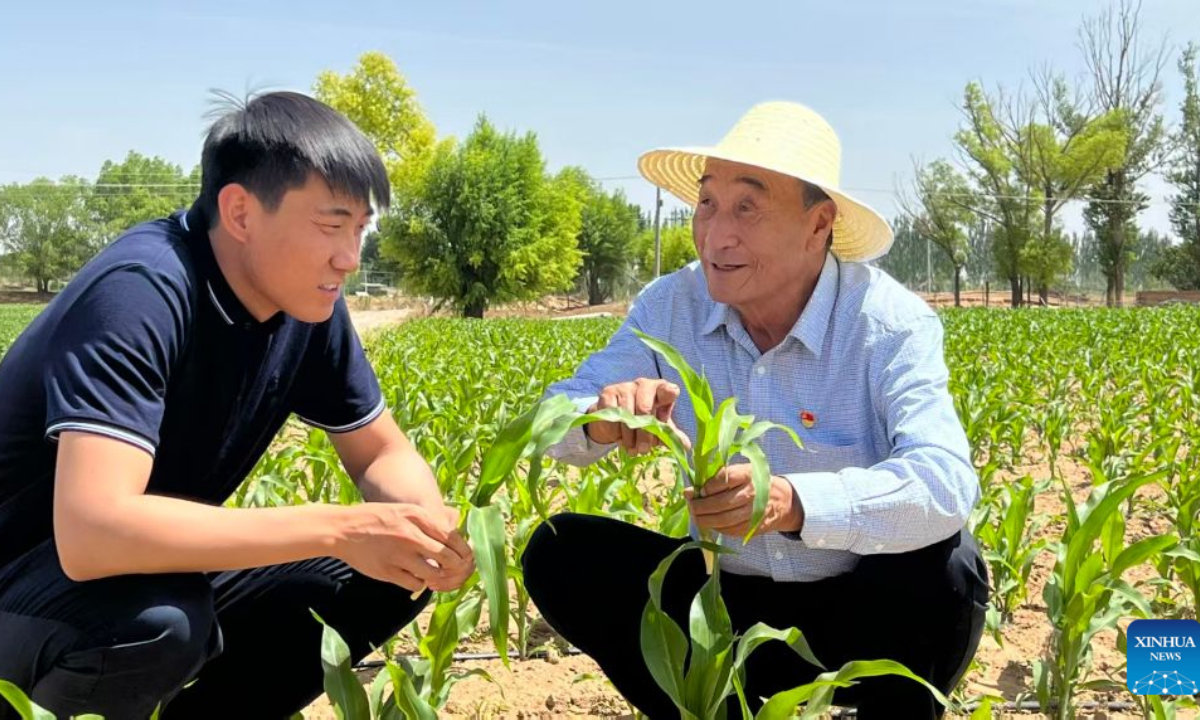
At 29, Shi belongs to a new generation of desert-control workers equipped with drones, machines and remote irrigation systems. An earth auger can now do in a day what once required about 200 laborers, while a single phone can control drip irrigation across more than 1,000 mu (about 66.67 hectares) of woodland.
For the older Shi's generation, the challenge was getting trees to survive in moving dunes. For the grandson, it is figuring out how to make those forests healthier and more resilient for decades to come.
Their story captures a broader shift in desert control along the southern edge of the Maowusu Desert in northwest China's Shaanxi Province: turning shifting sand into forest was only the beginning.
In 1986, Shi Guangyin, Shi Jianyang's grandfather, led more than 300 villagers into Langwosha, a sandy area in Dingbian County in Yulin City. He had raised 60,000 yuan (about 17,377 U.S. dollars at the time) by selling his family's 84 sheep and borrowing from relatives and banks to contract 3,500 mu of barren sandy land.
The early setbacks were severe. Strong winds destroyed about 90 percent of the saplings in the first year, and about 80 percent of those planted the following year failed to survive.
After seeking advice from forestry experts, Shi and the villagers laid out checkerboard-shaped barriers on windward slopes to hold the sand in place, then planted trees, shrubs and grasses within them. Sapling survival rates rose to about 80 percent.
Over the next four decades, Shi and those working alongside him treated 250,000 mu of sandy and saline-alkali land, with more than 53 million trees and shrubs taking root.
Greening the Maowusu Desert is part of a much larger national undertaking. It is one of the three major battlefronts of China's Three-North Shelterbelt Forest Program, a decades-long effort to curb desertification across northern China.
China has made desertification control a national ecological priority. Since 2023, the country has stepped up efforts under the program, with greater emphasis on systematic restoration and on consolidating earlier gains.
Decades after the first trees took root, a new challenge emerged. Poplars planted decades ago for their rapid growth began reaching the end of their life cycle, with large numbers of trees dying, while forests dominated by a single species were more vulnerable to pests and disease.
Making a forest was one challenge. Keeping it healthy for another generation is another.
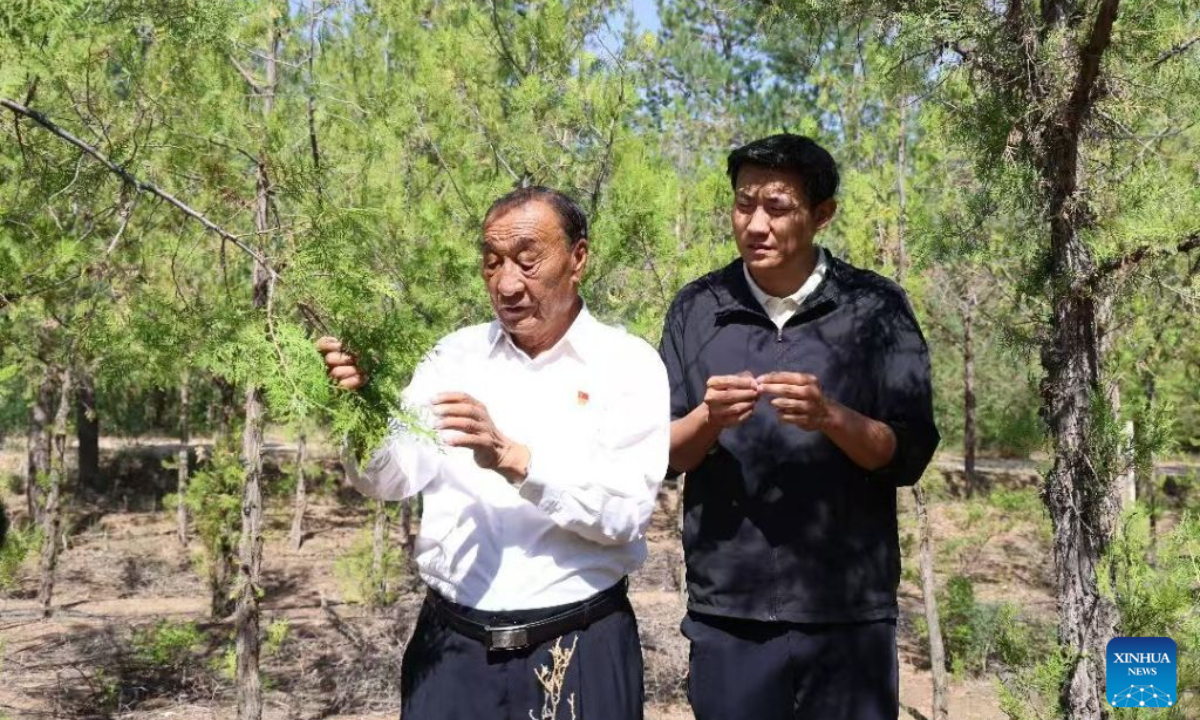
Shi Jianyang grew up watching his grandfather and father work to hold back the sand. His father, Shi Zhanjun, spent years planting trees alongside Shi Guangyin before dying in a road accident in 2008 while transporting saplings.
As a boy, Shi Jianyang sometimes resented the work that had taken his father. He spent summer holidays in makeshift tents in the sandy land, eating meals gritty with sand. During planting season, his father would return home with painful blisters in his mouth.
Yet he eventually chose forestry himself.
After studying forestry technology in university, Shi returned home in 2020 and began working in desert control. His team, initially made up of just seven or eight young locals, later brought in university graduates with expertise in soil science, landscaping and pest control.
The younger generation faced a different question: not simply how to make trees survive, but how to make a forest last.
Shi and his team spent more than 40 days in a 5,000-mu woodland setting up sample plots, measuring rainfall, studying soil microorganisms and tracking tree lodging. They proposed renewing aging forests with better-planned forest structures and expanded the planting of Mongolian pine, a long-lived evergreen species that had been successfully tested locally.
To date, about 50,000 mu of land has been planted with Mongolian pine. As some trees fail to survive and require replacement in subsequent planting seasons, the cumulative area of planting operations has reached about 65,000 mu.
Technology has also changed daily work. Drones patrol forests from the air, mechanized equipment dig planting pits, and irrigation can be managed remotely. Sapling survival rates, which Shi Guangyin's generation had raised to about 80 percent through improved sand-control and planting methods, have climbed further to about 92 percent with greater mechanization and more precise management.
Shi said the changes can be felt on the ground. Strong sandstorms have become rare, winds are weaker inside the forest, and the ground stays moist longer after rain. Summer days beneath the trees also feel cooler, while morning dew appears more often. The changes lead him to rethink desert control.
His approach also reflects a broader effort in China's desert regions to link ecological restoration with local livelihoods, giving communities a stronger economic stake in protecting restored land.
With his grandfather's support, Shi and his team have been looking for ways to make better use of the restored land as ecological conditions improve. They have developed potato seedlings suited to sandy soil, promoted greenhouse farming, and set up a livestock cooperative, while increasingly growing potatoes, watermelons and peppers on land once prone to losing water and nutrients.
Shi has also turned to livestreaming e-commerce to market potatoes and other local farm produce, while developing forest-based health and leisure projects. More than 2,000 local residents have seen their incomes rise steadily as farming, livestock breeding and other businesses have developed.
"We used to fear the sand and keep away from it. Now we understand it and know how to make use of it," Shi Guangyin said. "Today, there are opportunities to make a living everywhere in this sandy land."
Across Yulin, forest coverage has risen from 1.8 percent in 1949 to 34.8 percent, while shifting dunes that once encroached on villages have been brought under control.
For Shi Jianyang, however, the green landscape is not proof that the work is finished. "Planting a tree is not difficult," he said. "The difficult part is looking after it for decades."
The grandfather generation learned how to stop the sand. The young generation is learning how to make what grew there last.
。 Netflix has officially announced its upcoming original film, Toaster, a dark comedy based on the unexpected chaos after a cancelled wedding. Directed by Vivek Das Chaudhary, the film is scheduled to premiere on the streaming platform on April 15, 2026. The story explores a situation where a wedding is called off after gifts have already been exchanged. The plot begins with a petty fixation on a specific gift, a toaster, and follows a simple miser (Rajkummar Rao) as his pursuit to recover the item leads to ridiculous and escalating chaos and drama. The film marks a professional milestone for Patralekhaa, as it is the first production under her and Rajkummar Rao’s banner, Kampa Film. The project stars Rajkummar Rao and Sanya Malhotra, supported by an ensemble including Archana Puran Singh, Abhishek Banerjee, Farah Khan, Upendra Limaye, Vinod Rawat, Jitendra Joshi, and Seema Pahwa. About the production, Patralekhaa, producer of Kampa Film, said, “Stepping into production with Kampa Film has been an incredibly meaningful milestone for us, and beginning this journey with Netflix, who have consistently championed distinctive and unconventional stories makes it even more special. Toaster immediately stood out because it finds humour in the most unexpected places, and the moment we read it, we knew it was a story we wanted to bring to life.” View this post on Instagram A post shared by Netflix India (@netflix_in) Ruchikaa Kapoor Sheikh, Director of Original Films, Netflix India, mentioned that the film aligns with the platform's focus on inventive storytelling and emerging talent. She said, “Toaster is a quirky dark comedy that begins with a simple miser whose life spirals into complete mayhem in pursuit of getting back his toaster. It’s the kind of inventive storytelling we love to champion at Netflix. With Vivek Das Chaudhary making his directorial debut and Patralekhaa & Raj stepping into the producer’s role for the first time with Kampa Film, the project reflects our continued focus on championing emerging talent behind the camera while bringing an exciting burst of fresh creative energy.” The film's story and screenplay are credited to Parveez Shaikh, with Akshat Ghildial and Anagh Mukerjee also serving as screenwriters. Akshat Ghildial has also penned the dialogues. Toaster will be available for streaming on Netflix from April 15.Also Read: Toaster Teaser: Rajkummar Rao and Sanya Malhotra promise chaos and laughs。
Current article:http://www.kelozhaichongbaoshuo.pics/lywo3q/wat.htm
Published on:21:42:44


