李连杰
Exclusive: Brazilian soybean industry expects historically high export volumes to China: association_我的网站

一 |
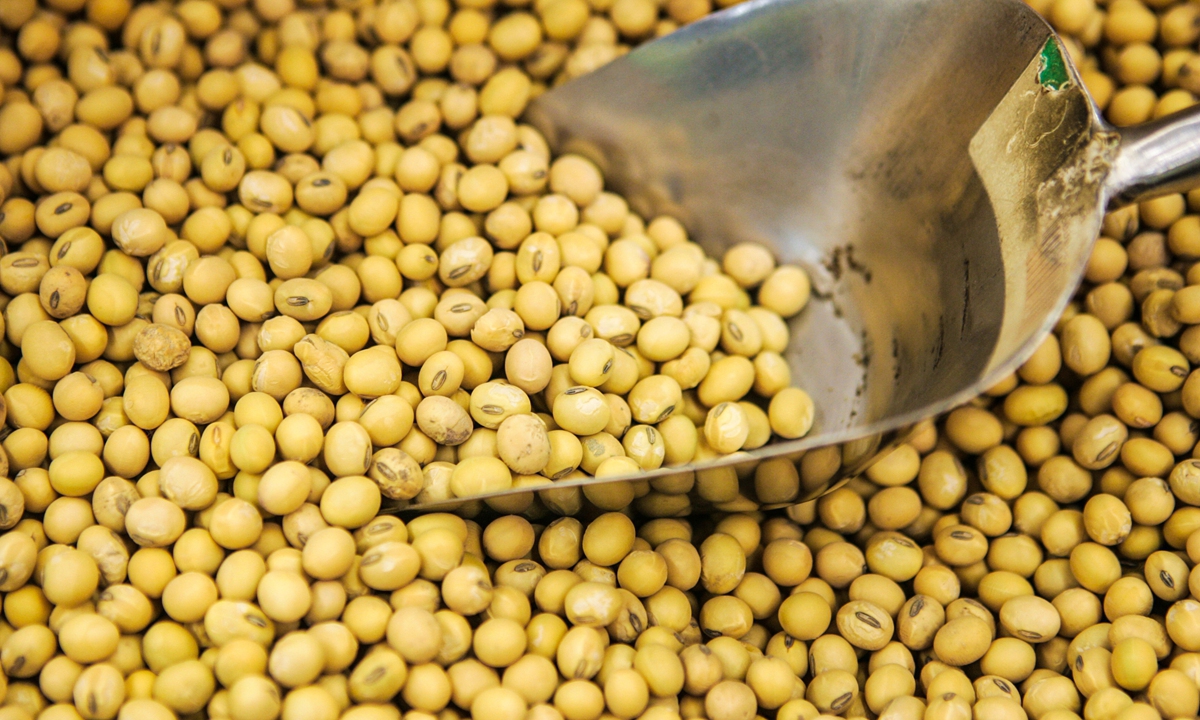
China continues to be the leading destination for Brazilian soybeans, and the Brazilian soybean industry wants to further deepen this relationship, expecting historically high volumes in the coming months, the Brazilian Association of Soybean Growers (Aprosoja Brasil) told the Global Times on Friday.
Brazilian soybean exports to China have remained very strong. China imported 12.08 million tons of soybeans from Brazil in June, up 13.7 percent year-on-year, while imports from the US fell 20.9 percent year-on-year to 1.27 million tons, according to data from the General Administration of Customs.
China imported 34.75 million tons of soybeans from Brazil during the period, up 9.1 percent year-on-year, according to Aprosoja Brasil. "Based on arrivals and customs clearance in China, there was clear growth," the association said.
According to the official data platform Brazilian Comex Stat, which records shipments at origin, 48.32 million metric tons were destined for China from January through June, largely unchanged from 48.41 million metric tons during the same period in 2025.
The difference between the two datasets mainly reflects timing and methodological differences between the recording of departures, cargoes in transit, arrivals and customs clearance.
Aprosoja Brasil said that the broader economic conclusion is the same: "Trade flows remained historically strong, China continued to be the leading destination for Brazilian soybeans, and Brazil's total soybean exports reached a first-half record of 69.57 million metric tons."
For farmers, strong export volumes help support the marketing of the crop, although record exports do not automatically mean record farm margins, said the Brazilian industry association.
China is the world's largest soybean importer. Imported soybeans are mainly used for oil production and animal feed. In terms of trading partners, China mainly imports soybean-related products from Brazil, the US, Argentina, Uruguay and Canada.
Brazil ranks among the world's leading soybean producers and exporters, with China being its largest export market for soybeans, according to the Xinhua News Agency.
Commenting on the significance of the Chinese market, Aprosoja Brasil said "China is absolutely strategic to Brazil's soybean industry," citing data showing that in 2025, China purchased 85.4 million metric tons, representing approximately 79 percent of all Brazilian soybean exports.
The two countries also have a highly complementary trade relationship. For Brazilian farmers, Chinese demand provides scale, market liquidity and greater capacity for long-term planning, said the Brazilian soybean industry association. For China, Brazil offers large, competitive and reliable supplies, as well as a crop calendar that complements production in other supplying countries.
Previously, policy shifts, such as US unilateral tariff measures, have caused disruption for US soybean farmers and other agricultural producers, Lü Xiang, research fellow at the Chinese Academy of Social Sciences, told the Global Times.
At the same time, China has been diversifying imports, including from Brazil and Argentina, to reduce risks from trade uncertainty, according to Lü.
Aprosoja Brasil noted that this partnership should not be seen merely as a temporary consequence of trade disputes involving third countries. Instead, it is a structural and mutually beneficial relationship, based on the complementarity between Brazil's production capacity and China's large demand for food, animal feed and protein, the industry group said.
Looking ahead to the soybean trade for the rest of the year, Aprosoja Brasil said that they are positive, while having a prudent mindset. Brazil has completed the harvest of a record soybean crop of approximately 180.6 million metric tons, and Brazilian soybean exports are expected to reach 116.3 million metric tons in 2026, which would also be a record, the association said.
"Brazil therefore has sufficient supply to continue serving the Chinese market strongly in the coming months... We expect historically high volumes, although not necessarily growth every single month, because soybean trade is seasonal and Northern Hemisphere supplies become more prominent during the second half of the year," it said.
。

二 | 车辆将会配备七速DSG自动变速箱,可选前驱或quattro四驱系统,此外,新车还将提供纯电续航里程超过100公里的插电式混合动力(PHEV)车型。不过具体的动力参数目前还不清楚。

三 | 虽然奥迪e-tron GT quattro和奥迪Q3两款车差别很大,但就单看前包围的整体轮廓还是有些相似的。同时,车头采用标志性的大尺寸六边形中网轮廓,内部为蜂窝状的镂空。下包围中部为更加密集细小的蜂窝进气,大面积的格栅镂空设计使整车看起来性能范儿十足,不得不说在如今众多新能源车型封闭式前脸的审美趋势下,这样的造型真是久违了。

四 |

五 | 通过车窗后侧三角窗位置的大小就可以看出,相比现款更长。

六 | 同时,这样的造型也使车尾看起来更饱满。小溜背的车顶线条结合车尾扰流板的延长,进一步拉伸侧面车身,整车更具运动感。车门下方以及侧裙位置的筋线设计更具动势,采用斜向的纵深造型,相比现款的平均造型,使车辆显得更加动感。

七 | 至于中网以及下方格栅则没什么悬念,尽可能的按照谍照还原就是了。

八 | 这样一来,未来等奥迪Q3在国内正式之后,我们甚至可以用Q3的价格买到Q5的空间体验。虽然不在一个级别,但是大家可以看到BBA三家中的宝马X3以及奔驰GLC在换代之后都进行了加长,宝马X3更为夸张,已经达到了海外版X5的尺寸。

九 | 所以我们觉得让全新Q3再长一些也没什么不妥,而且从视觉效果上看也没什么违和感。

十 |

十一 | 下方灯组由一条贯穿式灯带将其连接起来,上方灯组则由中部向两侧逐渐放大,这样也进一步拉伸了车尾的横向视觉宽度,是整体姿态更加运动。

十二 | 车尾下包围造型与车头相呼应,但是谍照中的设计明显没有完成,过于单调。所以我们在其内部加入和格栅装饰,并将其轮廓采用金属镀铬点缀。

十三 | 最下方的小扩散器造型一定会保留,为车尾增添了不少的运动气息。
Current article:http://www.kelozhaichongbaoshuo.pics/ectuvp/77hfk.html
Published on:13:11:18


