

父女七日变


分类: 特搜战队刑事连者
谷歌翻译
Naslen Gafoor Turns 25: The Unassuming Meteor Of Malayalam Cinema_我的网站

A | In an industry celebrated for its grounded storytelling and ever-expanding creative scope, Malayalam cinema has always had a sharp eye for talent that can carry both wit and weight. And yet, there are some actors who arrive not with a bang, but like a slow-burning ember: steady, self-assured, and impossible to ignore once the smoke clears. Naslen K Gafoor is that ember. At 25, he already carries the quiet confidence of someone who knows exactly where he belongs: right at the heart of the new Malayalam wave. Hailing from Kodungallur in Kerala, Naslen’s screen debut in Thanneer Mathan Dinangal (2019) wasn’t designed to steal the spotlight. But it did. As Melvin, the motormouth classmate with a knack for sly digs and one-liners, Naslen didn’t just elicit laughs. He exuded that rare quality of feeling entirely unscripted. That natural ease, a kind of controlled chaos wrapped in charm, immediately caught the audience’s attention. Here was someone who wasn’t trying to act cool, he just was. But what sets Naslen apart is not just how he began, but what he’s done since. The Steady Curve of Craft In an industry that often rushes to anoint its next sensation, Naslen has taken a more grounded path, one that reflects not the frenzy of overnight stardom, but the finesse of patience. Following his debut, he moved into darker terrain with Kuruthi (2021), a tense, socially charged thriller where he played Rasool, a teenager navigating communal tension and moral ambiguity. The film’s heavy tone was a sharp detour from his comic roots, and Naslen, in a role that could’ve easily been overshadowed, held his ground with a calm, brooding restraint. In Home (2021), a touching domestic drama, he slipped into the role of a millennial son with the same kind of quiet conviction. And in Keshu Ee Veedinte Nadhan, even in a smaller role, he managed to bring levity without ever feeling like filler. There’s an elasticity in his performances; one that doesn’t demand space but earns it. This ability to shapeshift without calling attention to the shift is what makes Naslen a standout in his generation. He doesn’t rely on gimmicks or heightened theatrics. He understands tone, rhythm, and, most importantly, silence. There’s power in the pauses, and Naslen knows where to place them. The Premalu Phenomenon Then came Premalu (2024). The film was never designed as a megahit, but like the best of Malayalam cinema, it found its resonance in relatability. As Sachin, a kind-hearted, emotionally awkward engineering graduate navigating unspoken feelings and second chances, Naslen delivered a performance that was both endearing and exact. The kind of role that required an actor to be funny without clowning, vulnerable without sobbing, and hopeful without being naive. He nailed it. What followed was nothing short of a sensation. Premalu shattered expectations at the box office, becoming one of the top-grossing Malayalam films of all time. But perhaps more interesting than the numbers was the public reaction. Even as the film’s success was celebrated, there was a quiet murmur among fans online: Why was Naslen, the heart of the film, missing from the spotlight? It wasn’t outrage, just a collective acknowledgment that the actor who made you feel the most was somehow being spoken about the least. In some ways, that reflects Naslen’s approach to fame. He’s not elbowing his way to the centre. He’s more comfortable on the fringes, letting the work speak. And yet, it’s impossible not to notice when the voice is that clear. Jojo Johnson and the Boxing Ring If Premalu was the quiet breakthrough, Alappuzha Gymkhana (2025) was the full-bodied leap. As Jojo Johnson, a carefree college kid thrust into the sweaty, brutal world of amateur boxing, Naslen offered a performance that required physical grit and emotional growth. He trained, transformed, and threw punches that didn’t just hit faces but landed emotionally. What could’ve been a conventional sports flick turned into something more nuanced, and Naslen was at the centre of it all. It became a summer hit, reaffirming that this wasn’t a fluke. He could now headline films, and carry them, weight class included. The Road Ahead: Superheroes and Sequels The Malayalam film industry, while deeply rooted in realism, has begun to flirt more freely with scale and spectacle. Naslen’s upcoming ventures are proof of that shift. A much-anticipated Premalu sequel is in the works, albeit delayed, and more intriguingly, he’s been cast in Lokah: Chapter One – Chandra, a superhero film backed by Dulquer Salmaan’s Wayfarer Films. The Charm of the Unbranded Star At a time when branding often outweighs performance, Naslen is an outlier. He isn’t everywhere, and maybe that’s the trick. His face isn’t on every poster, and he doesn’t flood feeds with curated content. What you get, instead, is the feeling that when he is on screen, you’re about to watch something real. Something lived-in. There’s no desperation to “arrive.” He’s already here, just taking the long way around. The Long Game Naslen Gafoor represents a kind of career arc that’s becoming increasingly rare; where each role is a rung, not a pedestal. He’s building something, not grabbing it. The comparisons to stars like Nivin Pauly or Fahadh Faasil are inevitable, but also unfair. He isn’t mimicking a template; he’s sketching his own. He may not yet be the most visible name in the industry but make no mistake: he’s being watched—by fans, by filmmakers, and by a generation of actors learning that charm doesn’t always need volume. See Also: Ranbir – Alia wedding: Alia Bhatt’s Juhu home gets decorated。
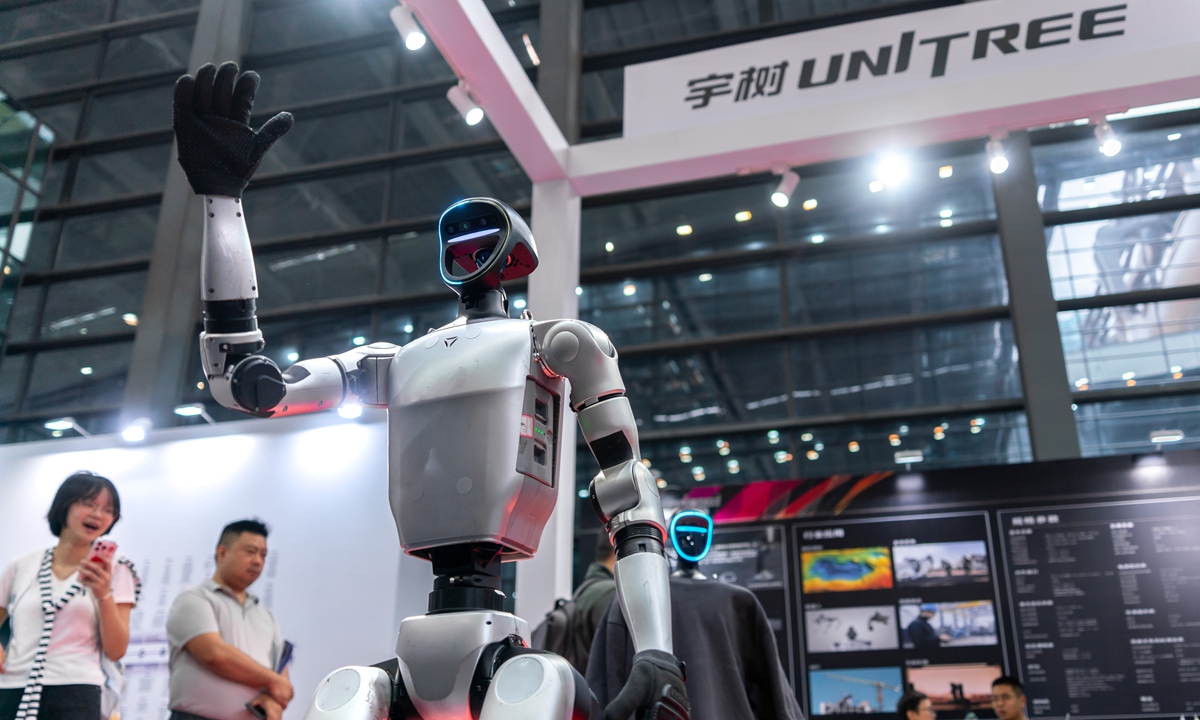
With just one day to go before Chinese humanoid robotics pioneer Unitree Robotics opens subscriptions for its initial public offering (IPO) on Shanghai's STAR Market, investor attention has extended far beyond the company itself, highlighting a broader capital-market rush into embodied intelligence as the sector moves from technological breakthroughs toward commercialization.
As of press time, discussions surrounding the IPO have pushed the topic to the top of trending lists across multiple stock trading platforms. The debate has focused on Unitree Robotics' disclosed short-term financial performance, as well as the potential opportunities for investors from China's policy push to include embodied intelligence and humanoid robots among key areas of medium- and long-term technology and industrial development.
Experts said the wave of IPOs among robotics companies, including Unitree Robotics, represents a shift that allows robot makers to engage more directly with public markets and investors. It also brings companies at different stages of development and pursuing different technological paths into a common valuation framework, promoting market comparisons and competition.
At the same time, the capital-market boom is likely to accelerate a shakeout, separating companies capable of building sustainable business models from those that struggle to turn technological advances into commercial returns.
On Thursday, Unitree Robotics released its announcement on the IPO of shares and listing on the STAR Market. According to the announcement, the offering price was set at 150.80 yuan per share, valuing the company at approximately 61 billion yuan ($9.04 billion) upon listing.
Secondary-market professionals told the Global Times that demand for Unitree Robotics' IPO subscription could be extremely high, meaning the chances of individual investors securing shares are likely to be very limited.
Robotics is currently one of the few categories that can translate AI capabilities into tangible assets with relatively comparable valuation metrics, creating a unique advantage in valuation narratives. This scarcity is one of the key factors drawing the attention of both large and small investors, Tian Feng, former dean of SenseTime's Intelligence Industry Research Institute, told the Global Times on Sunday.
Unlike large language model companies, whose capabilities are often assessed through benchmarks and demonstrations that are difficult for ordinary secondary-market investors to directly evaluate, robots offer visible and verifiable evidence through tasks such as grasping, walking and dexterous manipulation, Tian said. This tangible demonstration of "embodied" intelligence naturally creates a valuation premium in market narratives, he added.
Tian cautioned that extreme subscription figures, such as RobotHoenix's 14,855-fold oversubscription on its listing and LDRobot's 127.62 percent first-day share price surge, were driven by a combination of institutional advantages and sector scarcity rather than serving as evidence of the commercial validation of robotics products. He noted that there is no direct correlation between oversubscription multiples and the certainty of product deliveries or commercialization prospects.
Beyond Unitree Robotics, a broader financing boom in China's robotics industry has also gained significant momentum, with the Hong Kong Stock Exchange emerging as the main battleground for this latest IPO wave.
Citing industry data provider Wind, the China STAR Market reported that five robotics-related companies have gone public in Hong Kong so far in 2026. Meanwhile, 51 companies with businesses spanning industrial robots, service robots and embodied intelligence solutions are currently in the IPO pipeline in Hong Kong, accounting for 12.7 percent of all companies awaiting listing.
According to data from IT industry research platform ITjuzi.com, financing in China's embodied intelligence sector totaled 93.5 billion yuan in the first half of 2026, surpassing 90 billion yuan and marking a fivefold increase from the same period in 2025. The number of financing deals reached 322, up 137 percent year-on-year.
Tian said that while policy support and clearer commercialization pathways are boosting confidence in the sector, the latest IPO wave should also be viewed through a more cautious lens. The surge comes partly as the primary market's ability to continue funding embodied intelligence companies faces limits, prompting firms to seek new liquidity channels through public markets, rather than solely reflecting a dramatic leap in industrial maturity.
As emerging technology sectors increasingly become the focus of public attention, more objective and professional analysis is also needed to help investors assess companies' technological capabilities, commercialization prospects and long-term value, rather than simply following market enthusiasm, Chinese experts noted.
。

B |
Current article:http://www.kelozhaichongbaoshuo.pics/dbc/m8d.htm
Published on:07:46:29
- 警民携手护女孩 暖心救助获赞誉
- 连山区税务局 精准释放涉农税惠红利 助力企业可持续发展
- 深圳瑞捷:半导体洁净室业务尚处市场拓展期 收入占比较低
- 公安部:“猎狐行动”10年来追赃挽损近490亿元
- 政声直达丨雄安新区构建人工智能产业创新体系


