


浪漫刺客
(乡村行·看振兴)山西繁峙:特色农业赋能乡村 “链”起千户增收路,(乡村行·看振兴)山西繁峙:特色农业赋能乡村 “链”起千户增收路_我的网站

A | 忻州8月24日电 题:山西繁峙:特色农业赋能乡村 “链”起千户增收路 作者 杨静 钟昱星 初秋,正值农作物田间管护的关键时期。
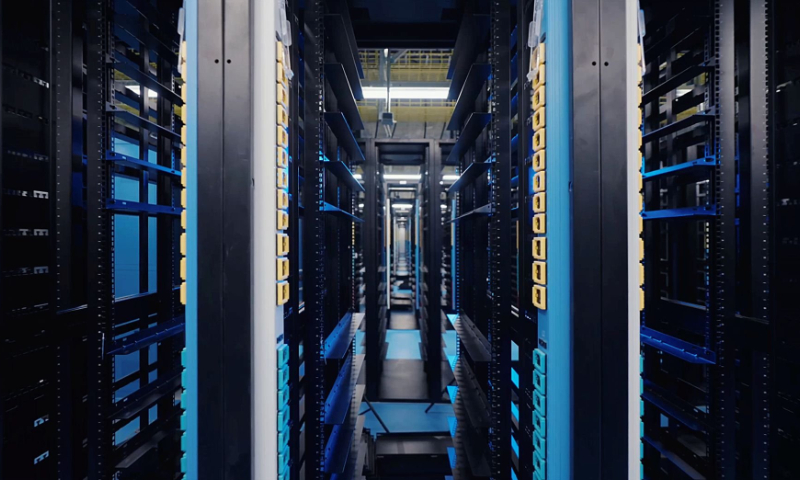
As more Chinese companies choose to stack data centers in a lesser-known city in Northern China, seeking cheaper land, electricity and cooler climate, Chinese industry experts said on Friday that the country's institutional advantages in developing AI are being fully demonstrated, providing solid support for an emerging industry that is continuously promoting welfare globally as an international public good.
China's green technology company Envision Group announced that its Envision Galaxy Campus - a large-scale AI data center (AIDC) - in Ulanqab officially entered operation on Thursday. It is also the single AIDC with the largest token output capacity in the world, Chinese green technology company Envision Group said in a statement sent to the Global Times on Friday.
Envision Group said its Envision Galaxy Campus in Ulanqab, with a planned total capacity of 2 gigawatts, integrates renewable energy, intelligent power management and high-density computing at unprecedented scale.
Envision is not the only Chinese company interested in building an AI data center in Ulanqab.
Recently, Chinese AI start-up DeepSeek posted a job opening for a senior data center operations and maintenance engineer, listing "Ulanqab" as the work location, which analysts said "hinted at a new data center of DeepSeek."
A recent report by Bloomberg also indicated that DeepSeek is also planning a massive AI data center there, citing people familiar with the matter. The report describes the project as "an ambitious move" in computing infrastructure from the start-up that's shown it can compete with the leading AI models of Silicon Valley.
DeepSeek is looking to add 1 gigawatt worth of compute in Ulanqab, about 350 kilometers northwest of Beijing, the report said. The announced and planned AI data centers are the latest addition to more than a dozen firms that have projects planned in the city.
Chinese experts said that these data centers located in Ulanqab, with its cool and dry climate, enjoy a natural advantage in heat dissipation that accounts for a major part of a data center's maintenance. But it is more than that. The city's status as a massive producer of clean energy as well as a hub of China's national computing power network, and a national development blueprint that goes back for years, are behind the companies' decisions, and these factors together are a vivid display of China's institutional advantage.
Unique advantage
Envision told the Global Times that its Envision Galaxy Campus features an area of 120,000 square meters, roughly equivalent to 20 standard football fields, and supports the computing capacity for 1 million graphics processing units (GPUs) in parallel, making it the AIDC with the highest token output capacity globally and setting a new benchmark for compute density in AI infrastructure.
With a purposely built proprietary AI Power System that enables stable, high-efficiency power transmission and energy storage just like a "power expressway and electricity granary", the facility can deliver up to ten times compute output per square meter more than conventional data centers.
Explaining why Ulanqab was chosen as the facility site, Envision said the city is one of the eight digital infrastructure hubs of the national "east data, west computing" project, allowing the center to have minimal latency for online computing tasks - a required feature as the number of GPUs multiplies at AI clusters.
Some 67 percent of the area's electricity is generated from wind and solar, making the base an ideal place to tap green energy, the company noted, adding that it aims to develop 5 gigawatts of green AIDC capacity in desert and arid regions worldwide by 2030.
"Light travels at roughly 300,000 kilometers per second. But when it comes to supercomputing, latency becomes a matter so the physical distance between computing demand and computing capacity becomes a factor to be considered," Ma Jihua, a veteran technology industry analyst, told the Global Times on Friday.
"The AI computing clusters will effectively serve demand generated in Northern China, particular the Beijing-Tianjin-Hebei region, where the digital economy is growing fast," Ma said.
Tian Feng, former dean of SenseTime's Intelligence Industry Research Institute, said that companies' selection of Ulanqab is more than a simple geographic location balancing - it is an act that reflects the underlying shift in companies' site-selection logic, as the compute paradigms shift from storage to training and inference.
To support the synchronous training of a cluster equipped with as much as one million GPUs, Envision needs to build its own wind farms and dedicated transmission lines; this is not merely a matter of "finding a cool spot to house server racks" but rather integrating power system engineering directly into the AI compute infrastructure, Tian told the Global Times on Friday.
"Data centers in the storage era have been passive consumers of the power grid. Now, in the AI training era, they require the grid to be custom-designed for them," Tian said. "This way, the energy company can lock electricity costs at its AI centers within a controllable range, giving it teeth for competition in the upcoming token economy era."
As the next frontier of AI is infrastructure, the cost of computing becomes a company's core competitiveness, Tian said.
By tapping rich renewable energy sources and direct power transmission from wind farm to data center, the electricity price at data centers in Hohhot, provincial capital of Inner Mongolia Autonomous Region and home to another data center cluster, is only one third of that in Beijing, domestic news portal bjnews.com.cn reported in June.
The unfolding story around Ulanqab also highlighted China's institutional strengths.
"The government drew up a plan, laid down the backbone of a national computing power network, and private-sectors companies followed up with their own investment, forming a self-reinforcing positive loop," Ma said.
To underpin AI growth, China's Government Work Report this year unveiled plans to launch new infrastructure projects focused on hyperscale intelligent computing clusters, alongside the coordinated development of computing capacity and power supply, according to the Xinhua News Agency.
Meanwhile, China's robust clean energy infrastructure and aggressive expansion plans for the upcoming five-year cycle are also poised to secure the critical power supply needed to meet the energy-intensive demands of AI computing.
The National Development and Reform Commission, China's top economic planner, said computing power network construction during the 15th Five-Year Plan period (2026-30) will lead to new direct investment of 4 trillion yuan ($592.68 billion), citing estimates by relevant institutions, the Securities Times reported on July 31.
Statistics show that by the first quarter of 2025, the total computing power of the eight data computing hubs of the "east data, west computing" project had reached 215.5 EFLOPS, with intelligent computing power accounting for 80.8 percent, according to Xinhua.
Computing power benefiting world
Yin Hejun, minister of Science and Technology, termed AI, robotics and innovative drugs as China's "new new three" at a recent policy briefing.
Ma said the expanding buildup of Chinese AI infrastructure reflects the strong growth of China's AI-related industries, which have emerged as new drivers of China's export growth, representing China's new core strategic industries and fresh economic growth engines.
As China's AI computing power grows, the country will be more well positioned to handle global demand, as it becomes the world's "token factory" by capitalizing on its energy strengths, Ma noted.
As China's technology exports now extend to digital services, with companies increasingly providing AI algorithms, cloud computing, and digital solutions to overseas markets, analysts said the competitively priced compute power from China will serve the world as an international public good in the emerging "token economy."
"In the future, computing clusters in Northern China will be ideal for handling computing needs generated from the Central Asian and Northeast Asian markets, due to its geographic proximity," Ma said.
Although some Western media outlets have recently targeted China's cost-effective AI products with a flurry of far-fetched skepticism in a bid to curb the growth of China's AI industry, Chinese AI products are already benefiting the world, analysts and industry insiders said.
For instance, Chinese AI company iFLYTEK said that its AI-powered intelligent teaching system has helped expand Chinese language learning worldwide and supported the digital development of Chinese education in overseas markets. The AI-powered intelligent Chinese teaching system has greatly expanded students' practice opportunities: On average, learners now speak Chinese 12 times per session, compared with only twice in regular classes at a Thai school, the company said.
As China embraces the concept of technology for good and inclusive AI to be shared by the whole of mankind, more people in the world will benefit from this trend, analysts noted.
。在山西省忻州市繁峙县作头村的绿色水稻种植基地,连片稻田绿意盎然。

B | 71岁的村民张福元正俯身田间打理着稻苗。

C | 这片土地不仅承载着他数十年的农耕记忆,更成为他如今增收致富的“聚宝盆”。 “家里的5亩地全部流转给公司,平时我在基地打工,一天能挣150元,比自己种地划算多了。

D | ”张福元说。通过“土地流转+就近务工”的双重保障,他在家门口捧稳了“饭碗”,享受到了县域特色农业产业发展带来的红利。 过去,当地农户长期面临分散种植、效益低下的困境。近年来,在当地农业龙头企业山西勇和农业养殖有限公司的辐射带动下,作头村及周边村落跳出传统农耕模式,探索形成“土地流转保底、就近务工增收”的发展模式。昔日闲置或低效的土地资源被盘活,变身成为农户手中稳定增收的“绿色资产”。 作为繁峙县本土重点农业产业化龙头企业,山西勇和农业养殖有限公司深耕现代农业,聚焦提质增效与延链补链,打造种植、加工、贸易一体化产业链。目前,企业已规模化建成750亩标准化绿色水稻基地、1000亩有机杂粮基地及2800亩天然牧草基地,并配套建设标准化农产品加工厂,构建起规模化、标准化、集约化的现代农业发展矩阵。

E | 图为山西省忻州市繁峙县作头村的绿色水稻种植基地。马艳青 摄 为破解传统小农种植分散、管理粗放、销路受限等难题,当地推行“公司+合作社+农户”的产业化经营模式。

F | 通过统一标准种植、统一精深加工、统一品牌销售,推动繁峙大米、特色杂粮等农产品提质升级、增值增效,带动县域农业产业迭代升级。 “今年基地预计可产出45万斤大米。销售方面,线上依托各大网络平台拓展市场,线下通过社区团购、商超入驻等多元渠道拓宽销路。

G | ”企业经理张芳介绍,预计今年企业大米、杂粮等产品销售额可突破2000万元。 目前,该企业已累计吸纳带动当地及周边1200余户、2000多名民众稳定增收,其中包含47户脱贫户,帮扶农户年均收入稳定在8000元以上。 繁峙县将立足县域农业资源优势,持续深耕特色农业,将资源优势转化为产业优势、富民优势,为乡村全面振兴注入动力。
Current article:http://www.kelozhaichongbaoshuo.pics/7kqh2l/20260826/17687.docx
Published on:12:15:02